


The Pyramids of Giza are the only one of the Seven Wonders of the Ancient World still standing, and they’re right on the edge of Cairo. Built about 4,500 years ago, the three great pyramids of Khufu, Khafre and Menkaure, the Great Sphinx and the tombs around them make one of the most famous sights on Earth. Since 2025 the visit has changed, with a new entrance, electric buses on the plateau and online tickets. Here’s everything you need to plan your visit: what you’ll see, how tickets work, how to get there and how to make the most of it.
Planning a trip? Start with our complete Egypt travel guide and our Egypt itineraries.
The pyramids at a glance
| Topic | The quick answer |
|---|---|
| Where | The Giza plateau, about 13 km (8 miles) southwest of central Cairo |
| Built | About 2600–2500 BC, in Egypt’s Fourth Dynasty |
| What’s there | The pyramids of Khufu, Khafre and Menkaure, six small queens’ pyramids, the Great Sphinx, temples and tombs |
| World Heritage | Part of the UNESCO site “Memphis and its Necropolis,” listed in 1979 |
| Time needed | 3–4 hours; a full day with the Grand Egyptian Museum next door |
| Tickets | Online or at the visitor center; going inside a pyramid needs an extra ticket |
| Best time | At opening time, from October to April |
The three great pyramids
The three great pyramids of Giza were built for the pharaohs Khufu, Khafre and Menkaure, and Khufu’s, the Great Pyramid, is the largest and the oldest.
The Great Pyramid of Khufu
The largest and oldest of the three was built for the pharaoh Khufu around 2560 BC. It rose about 146.6 m (481 ft) when it was finished and stands about 138.5 m (454 ft) today, after losing its top and its smooth outer casing. It’s made of an estimated 2.3 million stone blocks, and for more than 3,700 years it was the tallest structure ever built by people. It’s the oldest of the Seven Wonders of the Ancient World, and the only one that survives.

The Pyramid of Khafre
Built for Khufu’s son, Khafre, this pyramid is slightly smaller, but it often looks taller because it stands on higher ground and has a steeper slope. It’s the easiest one to recognize: near its peak, it still has some of the original smooth limestone casing that once covered all the pyramids.
The Pyramid of Menkaure
The smallest of the three, completed around 2510 BC, belonged to Menkaure. Next to it stand three small queens’ pyramids, and three more stand beside the Great Pyramid.


The Great Sphinx
Below the pyramids, the Great Sphinx, a lion with a human head carved from the bedrock, guards the plateau. It dates from Khafre’s reign, and most Egyptologists believe its face is Khafre’s. Next to it is the Valley Temple of Khafre, built of huge granite blocks. Read more in our guide to the Great Sphinx of Giza.
Can you go inside the pyramids?
Yes. With an extra ticket, you can go inside the Great Pyramid, climbing up through the tall, narrow Grand Gallery to the granite King’s Chamber. It’s steep, hot and humid, and the passages are low in places, so it isn’t a good idea if you don’t like tight spaces. There’s nothing painted inside: the experience is the sheer scale of the stonework. The pyramids of Khafre and Menkaure can also be entered with their own tickets, depending on which are open that day.

The new visitor experience
In 2025, the Giza plateau began a major overhaul to make visits easier and calmer:
- A new entrance and visitor center, with ticket sales, information and facilities.
- Electric buses on the plateau. 45 electric buses were introduced to carry visitors between the main stops, so you don’t need a car or a long walk in the sun.
- Online ticketing, so you can buy before you arrive.
- Vendors and animal rides moved to designated areas, to reduce congestion and hassle.
Arrangements are still changing, so check the latest details before your visit, or go with a local guide who knows how the new system works.
Tickets and opening hours
Buy tickets online on the official site, egymonuments.gov.eg, or at the visitor center: a general ticket for the plateau, plus separate tickets to go inside the pyramids.
- Where to buy: online on the official site of the Ministry of Tourism and Antiquities, egymonuments.gov.eg, or at the visitor center.
- What you need: a general ticket for the plateau, plus separate tickets if you want to go inside the Great Pyramid or the other pyramids.
- How to pay: payment at Egypt’s sites is mostly by card, so bring one, plus some cash for tips.
- Hours: the site opens early in the morning and closes in the late afternoon, a little later in summer. Check the current hours on the official site.
- Students: student tickets are available with a valid international student card.
Prices change, so check the current ticket prices on the official site before you go.
The Panorama viewpoint and the nine pyramids
For the classic photo of all the pyramids in a row, head to the Panorama viewpoint in the desert southwest of the pyramids. From there you can line up all nine pyramids: the three great ones and the six small queens’ pyramids. It’s a stop on the plateau’s bus route, and it’s the best place for a camel ride photo with the pyramids behind you.
- Camel and horse rides: agree on the price and the length of the ride before you get on, and choose animals that look healthy and well cared for.
- Light: the best photos are in the morning or late afternoon, when the light is softer.

How to get to the pyramids
The easiest way from central Cairo is a ride-hailing app (allow at least 45 minutes at busy times) or a guide with a driver.


- Ride-hailing: an Uber or similar app is the easiest way from central Cairo, depending on traffic (allow at least 45 minutes at busy times).
- With a guide or driver: the simplest option, especially if you’re combining the pyramids with the Grand Egyptian Museum, Saqqara or Dahshur.
- Stay nearby: many hotels in Giza have pyramid views and save you the drive.
- Once inside, use the plateau’s electric buses to move between the main stops.
How to plan your day
Arrive at opening for the three pyramids, then the Panorama viewpoint and the Sphinx, and spend the afternoon at the Grand Egyptian Museum.
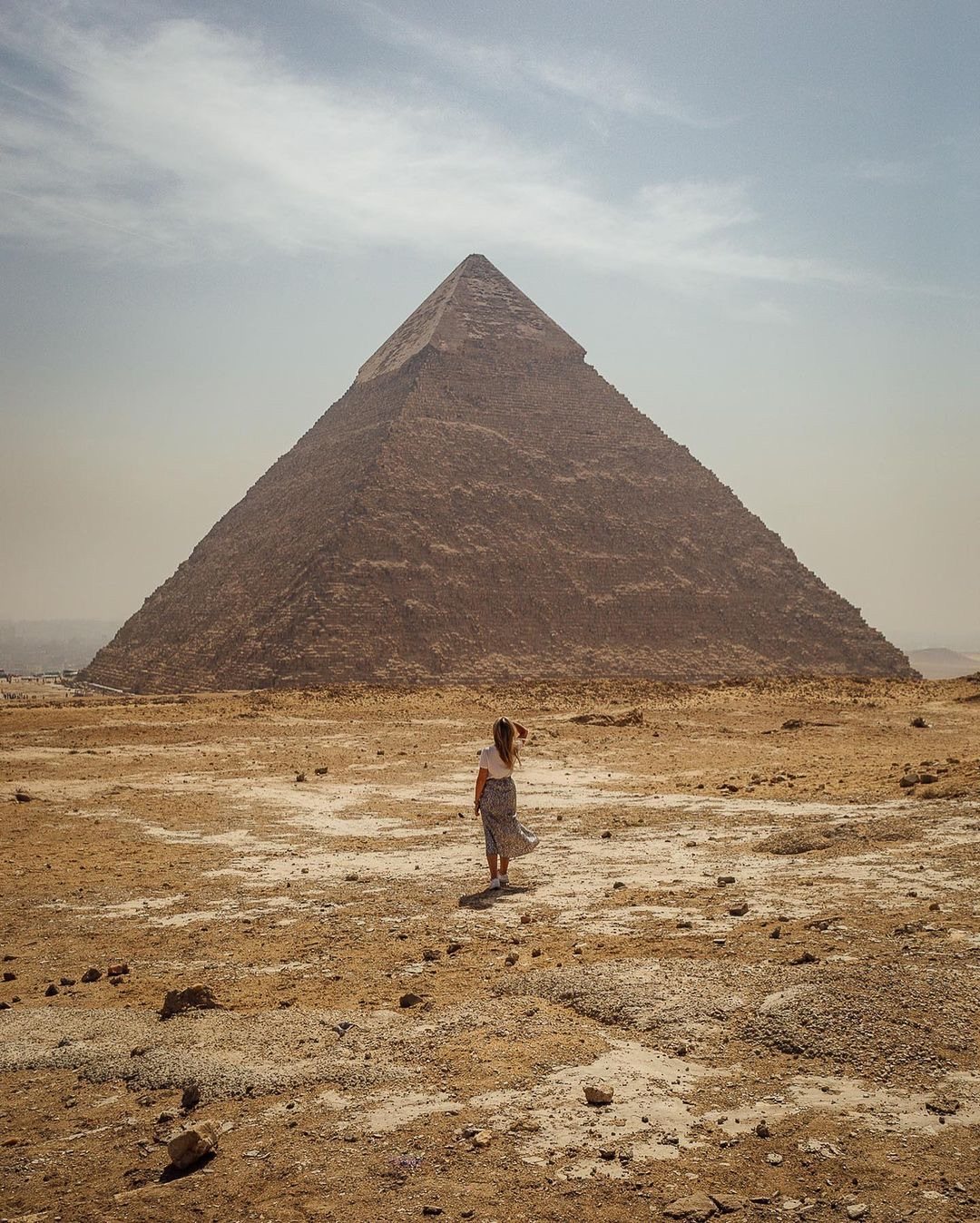
- Morning: arrive at opening. See the Great Pyramid first (and go inside if you’d like), then Khafre and Menkaure.
- Late morning: the Panorama viewpoint for the nine-pyramid view, then down to the Sphinx and the Valley Temple.
- Afternoon: the Grand Egyptian Museum, a short drive away, home to the treasures of Tutankhamun and Khufu’s ancient boat.
- Evening: the Sound and Light show, when the pyramids and the Sphinx are lit up after dark.
Got another day? Visit the older pyramids at Saqqara and Dahshur, including the Step Pyramid of Djoser and the Bent and Red Pyramids. See our Giza Necropolis, Saqqara and Dahshur guide.

Tips for a great visit
- Go early. The first hours after opening are the coolest and quietest.
- Bring water, a hat and sunscreen. There’s very little shade on the plateau.
- Wear good shoes for sand, stone and the climb inside the Great Pyramid.
- Ignore unofficial “guides.” Politely say “la, shukran” (no, thank you) to anyone offering help with tickets or directions.
- Go with a local guide to skip the hassle and hear the stories behind the stones.
- Check the season: October to April is the most comfortable. See the best time to visit Egypt.
Local-guided experiences
Our hosts in Giza and Cairo run these pyramid experiences:

Ultimate Giza Pyramids Tour – Sphinx, Camels & Egyptian Culture
The pyramids and the Sphinx with a local guide from Giza, with time on a camel and a taste of Egyptian daily life.

Half-Day Trip to the Giza Pyramids, Sphinx and a Camel Ride
The pyramids and the Sphinx in a morning with Mahmoud Fawzy, with a camel ride on the plateau.

Giza Pyramids Photoshoot: Nine Pyramids View and Panorama
A professional photoshoot at the Panorama viewpoint, with the nine pyramids lined up behind you.

Grand Egyptian Museum, Giza Pyramids and Sphinx
The pyramids and the Sphinx in the morning and the Grand Egyptian Museum in the afternoon, with Mahmoud Fawzy.

Saqqara, Memphis and Dahshur with Lunch
The oldest pyramids in Egypt, the ruins of Memphis and the Bent and Red Pyramids of Dahshur, with lunch.
Find a local guide: meet our local guides in Egypt.
Pyramids of Giza FAQ
How old are the Pyramids of Giza?
About 4,500 years. They were built in Egypt’s Fourth Dynasty, roughly 2600–2500 BC. The Great Pyramid of Khufu was finished around 2560 BC.
How tall is the Great Pyramid?
About 138.5 m (454 ft) today. When it was finished it stood about 146.6 m (481 ft), and it remained the tallest human-made structure for more than 3,700 years.
Can you go inside the Pyramids of Giza?
Yes, with an extra ticket. Inside the Great Pyramid you climb the Grand Gallery to the King’s Chamber. It’s steep, hot and narrow in places.
How do I buy tickets for the Pyramids of Giza?
Online on the official site, egymonuments.gov.eg, or at the visitor center. Going inside a pyramid needs a separate ticket. Payment is mostly by card.
How long do you need at the pyramids?
Three to four hours for the pyramids, the Panorama viewpoint and the Sphinx. Add an afternoon for the Grand Egyptian Museum nearby.
How far are the pyramids from Cairo?
About 13 km (8 miles) from central Cairo, on the western edge of the city. Allow at least 45 minutes by car at busy times.
What is the best time to visit the pyramids?
Arrive at opening time to beat the heat and the crowds, and visit between October and April for the most comfortable weather.
Sources
- UNESCO — Memphis and its Necropolis, the Pyramid Fields from Giza to Dahshur
- Giza pyramid complex (Wikipedia) and Great Pyramid of Giza (Wikipedia) — dates, heights, the Sphinx
- The National — Pyramids of Giza visitor experience revamp (2025) — electric buses, new access, online ticketing
- Egyptian Ministry of Tourism and Antiquities — tickets and opening hours
- Wikimedia Commons — photographs credited in each caption


