

Simsem Country Guide · Updated for 2027
Ahlan wa sahlan! Welcome to Syria. Few places hold so much history in so little space: the Old City of Damascus, the Aramaic-speaking village of Maaloula, Crusader castles, the Roman ruins of Palmyra and Apamea, the souqs of Aleppo and a green Mediterranean coast. Syria reopened to visitors in 2025, and travelers are coming back. This pocket guide covers where to go, what to know about safety and entry in 2027, what to eat, how to get around and the local hosts who will show you their country. Read the safety section before you plan: Western governments still advise against all travel to Syria.
- Best timeMar–May and Sep–Nov
- VisaOn arrival, often with approval first
- CurrencyNew Syrian pound; bring US dollars
- Trip length7–12 days
- LanguageArabic; English in tourism
- Travel adviceWestern governments: do not travel
Start here
Syria at a glance
Syria quick facts
All quick facts
Safety
As of November 2026, the US rates Syria Level 4, “Do Not Travel,” and the UK, Canada and Australia also advise against all travel, citing terrorism, kidnapping, armed conflict and regional strikes. The UK says it cannot provide consular support inside Syria, and travel insurance may be invalid if you go against official advice. Visitor numbers are rising, with 719,000 foreign visitors in the first half of 2026. If you decide to go, travel with a local host, avoid the areas of highest risk, get specialist insurance and follow the news every day. Read our full answer to is Syria safe to visit?
Discover
Where to go
Top things to do in Syria
Eight places that belong on a first trip to Syria, each with its own complete guide.
Where to go in Syria
Most first trips start in Damascus, add a day trip to Maaloula and continue west to Krak des Chevaliers and the coast. With more time, travelers go north to Hama and Aleppo or east to Palmyra with a guide. Here is the country region by region.

Damascus
One of the oldest continuously inhabited cities in the world. Walk Souq al-Hamidiyya to the Umayyad Mosque, visit the Citadel, which reopened in 2026, follow Straight Street into the Christian quarter and see the National Museum. Damascus is also the best place in Syria for street food and sweets. Read our guide to things to do in Damascus.

Maaloula and the Qalamoun mountains
About an hour north of Damascus, Maaloula is built into the cliffs and still speaks Western Aramaic. Visit the convent of Saint Thecla and the monastery of Saints Sergius and Bacchus, and continue to the desert monastery of Mar Musa. Read our Maaloula guide.
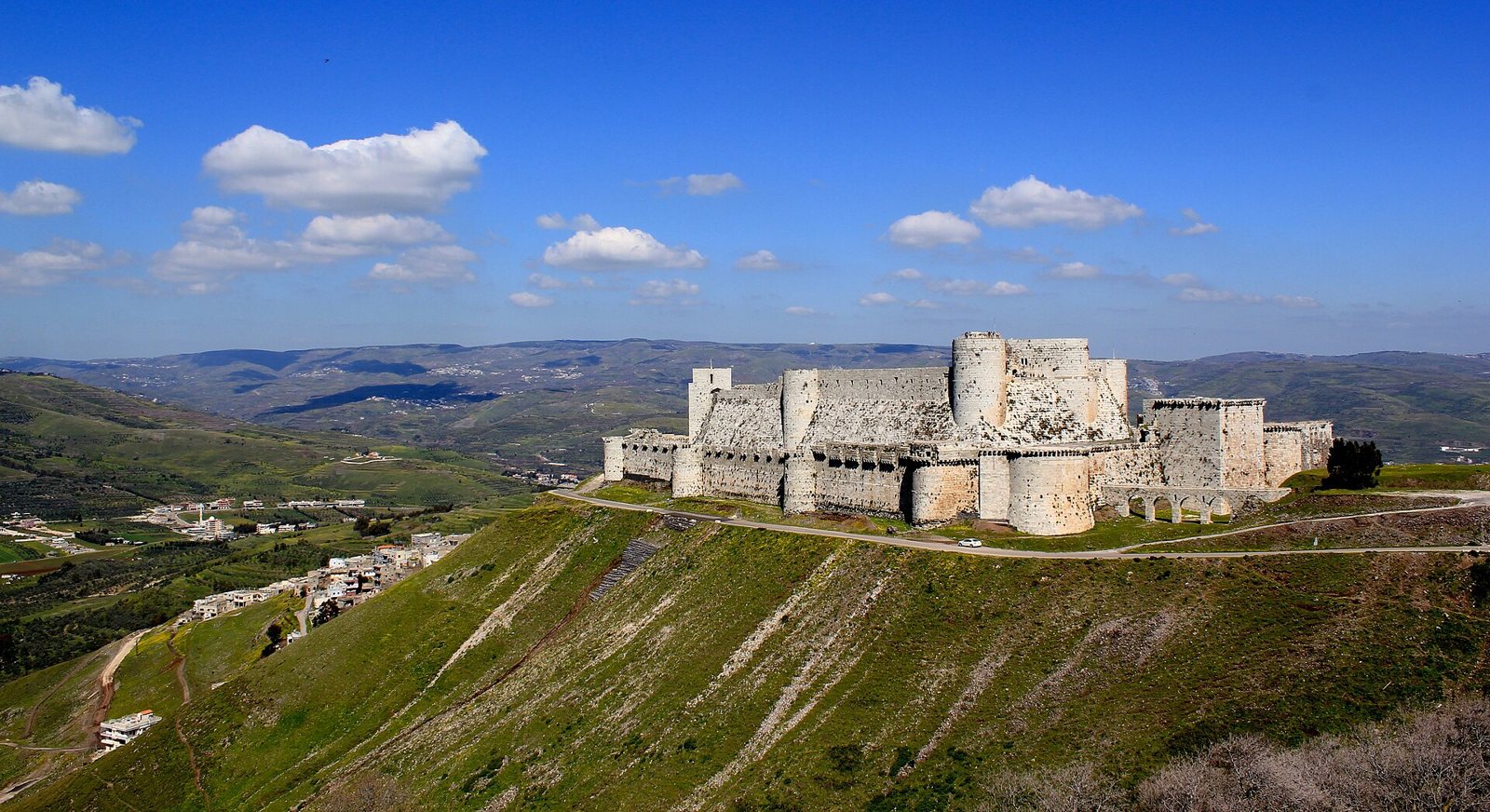
Krak des Chevaliers and Homs
The most famous Crusader castle in the world stands above the Homs Gap, between the interior and the coast. Its walls, towers and great hall are remarkably complete, and it is an easy stop on the way to Tartus.

The Mediterranean coast
Green mountains, beaches and fish restaurants. Take the boat from Tartus to Arwad, Syria’s only inhabited island, spend time on the beaches around Latakia and hike in the mountains around Chalma, Slunfeh and Qadmous. Read our Syrian coast guide.

Hama and Apamea
Hama’s giant wooden water wheels are turning again on the Orontes. Nearby, the Roman city of Apamea has one of the longest colonnaded streets of the ancient world. Read our guide to Hama and Apamea.

Aleppo and the north
Aleppo is reopening: the Citadel welcomed visitors again in 2025 and the Great Umayyad Mosque in October 2026, while the old souqs are still being restored. Aleppo is also Syria’s food capital. Read our Aleppo guide.

Palmyra and the desert
The great caravan city of the desert. The colonnade and theater still stand; the Temple of Bel and the Monumental Arch were destroyed in 2015. Visit only with a guide who follows the situation, and stay on marked paths. Read our Palmyra guide.
Map of Syria
Damascus is in the southwest. Maaloula is an hour north, the coast three to four hours northwest, Aleppo about five hours north and Palmyra about four hours northeast across the desert. Tap a number on the map to open that place’s guide.
Damascus is in the southwest. Maaloula is an hour north, the coast about three to four hours northwest, Aleppo about five hours north and Palmyra about four hours northeast across the desert.
Syria’s UNESCO World Heritage Sites
Syria has six sites on the UNESCO World Heritage List, and all six have been on the List of World Heritage in Danger since 2013:
- Ancient City of Damascus (1979): see our Damascus guide
- Ancient City of Bosra (1980), with its Roman theater in the south
- Site of Palmyra (1980): see our Palmyra guide
- Ancient City of Aleppo (1986): see our Aleppo guide
- Crac des Chevaliers and Qal’at Salah El-Din (2006)
- Ancient Villages of Northern Syria (2011), the “Dead Cities” west of Aleppo

Experience
Tours with local hosts
Syria experiences with local hosts
Local-guided experiences with Simsem hosts across Syria:

Damascus, Syria: Old City Walking Tour
A five-hour walk through Old Damascus with a local guide who knows its lanes, courtyards and stories.

Damascus Syria Day Tour | Old City, Umayyad Mosque & Cultural Experience
A full day in Old Damascus with a local guide: the Umayyad Mosque, the souqs and life in the old lanes.

Mar Musa Monastery Experience in Syria: Faith, Peace & Mountain Hiking
Two days at the Mar Musa monastery in the desert mountains north of Damascus, with time for quiet and the views.

Syria Heritage & Mountains Tour: Damascus, Maaloula & Krak des Chevaliers (3 Days)
Three days with a local guide from Damascus and Maaloula to Krak des Chevaliers and the mountains.

Syria Historical & Cultural Tour: Palmyra, Aleppo, Maaloula
Five days with Ahmad Khaled through Palmyra, Homs, Hama, Apamea, Aleppo and Maaloula.

Syria Heritage Journey: Castles, Coast & Ancient Cities
Six days with a local guide: Damascus, Crusader castles, the Mediterranean coast and Syria’s ancient cities.

East & North of Syria
Six days through Syria’s north and east with a local guide.

Syria 4 Day Camping Tour: Badrousiya Beach, Chalma Mountain & Mashqita Lake
Four days of camping on the Syrian coast: Badrousiya Beach, Chalma Mountain and the Latakia countryside.

Chalma Peaks Escape: Summit, Sunset & Camping in Latakia, Syria
Two days in the Latakia mountains: a summit hike, sunset over the coast and a night of camping.

Qadmous Escape: Mountains, Valleys & Waterfalls in Syria
Three days of mountains, valleys and waterfalls around Qadmous in the hills behind the coast.

Hiking & Camping in Al-Qadmus and Wadi Al-Jamajem, Syria
Two days of hiking and camping in the green hills of Al-Qadmus and Wadi Al-Jamajem near Tartus.

Al Marah Village Experience: Authentic Syrian Village Day Trip
A day in Al Marah, a village in the hills near Tartus, with a local host.

Syria Hama Historical & Nature Escape – Apamea, Shaizar & Al-Madiq Castles Tour
A day in Hama province: the colonnade of Apamea, Shaizar castle and the countryside around Hama.

Syria Countryside Escape – Hama Scenic Picnic & Village Experience
A relaxed countryside day near Hama with a picnic, village life and wide green views.
Plan
Plan your trip
Essential travel information
Three things are different about Syria compared with its neighbors: entry approval, cash and travel insurance. Sort all three before you book flights.
Visa and entry
Most nationalities get a visa on arrival at Damascus or Aleppo airport or at the land borders with Lebanon (Masnaa) and Jordan (Nassib). Many travelers, especially those who fly in, need entry approval arranged in advance through a licensed Syrian agency or tour host. The e-visa is not working yet. Israeli passports and passports with Israeli stamps can be refused. Full details in our Syria visa guide.
Money
Syria introduced a new Syrian pound in 2026, removing two zeros. Foreign bank cards are still unreliable, and local ATMs pay out Syrian pounds only, so bring enough US dollars in cash for the whole trip and change them locally.
Insurance
Standard travel insurance usually excludes countries under “do not travel” advice. Look for a specialist high-risk insurer that names Syria in the policy, including medical evacuation.
Best time to visit
First-time visitor guide: what to expect
Syria is welcoming and hospitable, and it is also a country recovering from a long war. A few things help first-time visitors.
- Hospitality: you will be offered tea and coffee often. Accepting is polite.
- Checkpoints: expect security checkpoints on main roads. Keep your passport with you.
- Photography: never photograph checkpoints, soldiers or military sites. Ask before photographing people.
- Dress: modest clothing is respectful everywhere; women cover their hair in mosques.
- Booking: hotel booking sites and ride-hailing apps are of little use. Book by phone or through your host.
- Power and connectivity: power cuts are common in many areas; hotels and guesthouses often run generators. Local SIM cards are available.
- Damage: you will see destroyed neighborhoods and damaged monuments. Be thoughtful when people talk about the war.
How many days? Sample itineraries
Seven days covers Damascus, Maaloula, Krak des Chevaliers and the coast. Add three to five days for Hama, Aleppo and Palmyra.
7 days: Damascus, Maaloula and the coast
- Days 1–2: Damascus: the Old City, the Umayyad Mosque, the National Museum and Mount Qasioun.
- Day 3: Maaloula and Saidnaya, or a night at Mar Musa.
- Day 4: Krak des Chevaliers on the way to Tartus.
- Day 5: Arwad island and the Tartus seafront.
- Day 6: Latakia and the mountains.
- Day 7: back to Damascus.
10–12 days: add Hama, Aleppo and Palmyra
- Follow the 7-day route, then go from the coast to Hama and Apamea.
- Continue to Aleppo for two days: the Citadel, the Great Mosque and the souqs.
- With a guide, cross the desert to Palmyra, staying overnight, and return to Damascus via Homs.
Getting around Syria
Most visitors travel by car with a driver or with their host. Distances are manageable, but checkpoints slow journeys down.
Typical drives: Damascus to Maaloula about 1 hour, to Homs about 2 hours, to Tartus about 3 to 4 hours, to Hama about 2.5 to 3 hours, to Aleppo about 5 hours and to Palmyra about 3.5 to 4 hours.
Flights to Syria
Damascus International Airport has scheduled flights from the Gulf, Turkey and Jordan. Qatar Airways, Turkish Airlines, Royal Jordanian and Emirates resumed flights in 2025, and more carriers have followed. Many travelers also fly to Beirut or Amman and cross overland. Services can be suspended at short notice because of regional tensions, so book flexible tickets.
Eat and drink
Food
Food: the taste of Syria
Syrian food is one of the great cuisines of the Middle East. Start with mezze, try kibbeh, the national dish, eat shawarma in Damascus and kebab in Aleppo, and finish with baklava, halawet el-jibn from Hama or booza ice cream in the old souq of Damascus. Read our full guide to Syrian food.

2027
Events and fun facts
Calendar highlights 2027
Religious holidays shape the year in Syria. Islamic dates are expected dates and depend on the sighting of the moon.
Did you know?
Travel with locals
About Simsem
Why travel with Simsem?
Local. Authentic. Community-driven.
From the founder
Raf Sarawi, CEO and Founder, Simsem
In 2014, I founded Maramiya Centre, a cultural center in Brussels, with a simple dream: to share the beauty and richness of Middle Eastern culture with the world. I watched as strangers became friends over shared meals, traditional music and heartfelt conversations. Those moments showed me the transformative power of authentic cultural connection.
That’s how Simsem was born: a platform that connects travelers directly with Middle Eastern locals, from the lanes of Old Damascus to the mountain villages above the Syrian coast. Our name, Simsem (سمسم), means “sesame” in Arabic, a humble ingredient that adds flavor and depth to countless dishes. Just like those tiny seeds, we aim to add authenticity and richness to your travels.
When you travel with Simsem, you’re not just seeing Syria’s ancient wonders. You’re sharing tea, meals and stories with the people who call it home, at a time when every visitor helps families rebuild.
Meet our local guides in Syria
Book directly with the people who live there. Each profile shows the host’s experiences.
- Rita Badran — Damascus and multi-day journeys
- Syria Beyond The News — Damascus and the Tartus hills
- Ahmad Khaled — The coast, Hama and journeys to Aleppo and Palmyra
- Lubana and Xavi — Mar Musa monastery
Every Simsem guide to Syria
Go deeper with our in-depth guides to Syria.
Plan your trip
Damascus and around
The coast and the castles
Central and northern Syria
Syrian food
Official resources
Questions
FAQ
Syria travel FAQ
Is Syria safe to visit?
Official advice says no: the US, UK, Canada and Australia all advise against all travel to Syria as of November 2026. Visitors are returning, with 719,000 foreign visitors in the first half of 2026, but risks remain across the country.
Can tourists visit Syria in 2027?
Yes. Syria is open to tourists, with visas on arrival for most nationalities, although many travelers need entry approval before they fly.
Do I need a visa for Syria?
Yes. Most nationalities get a visa on arrival at Damascus or Aleppo airport or at the Lebanese and Jordanian borders. The e-visa is not working yet.
What is the best time to visit Syria?
Spring, from March to May, and autumn, from September to November. Summer is hot inland but pleasant on the coast and in the mountains.
How many days do you need in Syria?
Seven days covers Damascus, Maaloula, Krak des Chevaliers and the coast. Ten to twelve days lets you add Hama, Aleppo and Palmyra.
What currency is used in Syria?
The new Syrian pound, introduced in 2026. Bring US dollars in cash, because foreign cards are unreliable.
What are the must-see places in Syria?
The Old City of Damascus, Maaloula, Krak des Chevaliers, Arwad and the coast, Hama and Apamea, Aleppo and Palmyra.
Can I visit Palmyra?
Yes, with a guide. The colonnade and theater still stand, the museum is closed and the surrounding desert was mined, so stay on marked paths.
Sources
- US Department of State — Syria Travel Advisory (Level 4, October 23, 2026)
- UK Foreign, Commonwealth & Development Office — Syria travel advice (October 27, 2026)
- Enab Baladi — 3.52 million visitors in the first half of 2026
- UNESCO World Heritage Centre — Syrian Arab Republic
- United Nations Treasury — Syrian pound redenomination
- Wego — Syria visa on arrival 2026
- Wikimedia Commons — photographs credited in each caption


