Nothing quite prepares you for the moment the Siq opens and the Treasury appears, carved straight out of the rose-colored rock. Petra, the ancient capital of the Nabataeans in southern Jordan, is a UNESCO World Heritage Site, one of the New 7 Wonders of the World and Jordan’s best-known sight. It is also far bigger than its most famous facade: a whole city of tombs, temples, a theater and mountain-top shrines spread across a valley you can easily spend two or three days exploring. This guide covers the story of Petra, what to see in the order you will meet it, the hiking trails, how many days you need, tickets and the Jordan Pass, and practical tips for your visit.

Petra at a glance
| Topic | The quick answer |
|---|---|
| Where | Ma’an Governorate in southern Jordan, next to the town of Wadi Musa |
| Built by | The Nabataeans, who made it their capital from the 2nd century BC |
| Status | UNESCO World Heritage Site since 1985; one of the New 7 Wonders of the World since 2007 |
| Don’t miss | The Siq, the Treasury, the theater, the Royal Tombs and the Monastery |
| Time needed | One full day for the highlights; two or three days to hike the trails |
| Tickets | Included in the Jordan Pass (1, 2 or 3 days of Petra entry), or bought at the visitor center |
The story of Petra
The Nabataeans settled here in the 4th century BC and made Petra — which they called Raqmu — their capital in the 2nd century BC. It grew rich as a hub on the incense trade routes, and survived in a dry, rocky valley thanks to an ingenious system for collecting and storing water. Its nickname, the “Rose City”, comes from the color of the sandstone it is carved from.
In 106 AD Rome annexed the Nabataean kingdom and made it part of the province of Arabia Petraea. An earthquake in 363 damaged many buildings and the water system; churches were still being built in the Byzantine period, but the city declined and was largely abandoned by the early Islamic era. For centuries only the local Bedouin knew it, until the Swiss traveler Johann Ludwig Burckhardt brought it to the attention of the West in 1812.
UNESCO inscribed Petra as a World Heritage Site in 1985 — the same year the Bdoul Bedouin, who had lived in Petra’s caves, were resettled to the nearby village of Umm Sayhoun — and in 2007 it was named one of the New 7 Wonders of the World. In 2019 it drew more than a million visitors.
The Siq

Every visit begins with the Siq, the narrow gorge that leads into the city. It runs about 1.2 km, is no more than about 3 meters wide in places, and its walls rise 90 meters or more above you. It isn’t a canyon carved by a river but a natural fault in the rock, split apart by tectonic forces and later smoothed by water.

Look out along the way for the Nabataeans’ handiwork: small niches in the walls that held sacred stones (which suggest the Siq itself was sacred), and the eroded remains of two statues of merchants leading camels — almost twice life-size — uncovered in 1998. At the entrance, a dam rebuilt in the 20th century still diverts flood water away from the Siq, following the Nabataeans’ own method.
The Treasury (Al-Khazneh)

The Siq ends in front of Petra’s most famous monument: a facade about 39 meters high and 25 meters wide, cut straight into the cliff. Despite its name, the Treasury was almost certainly a royal tomb, probably for King Aretas IV, carved at the beginning of the 1st century AD.
The name comes from legend. Local Bedouin believed treasure was hidden in the stone urn at the top of the facade — you can still see bullet marks where people shot at it — though the urn is solid sandstone. Look for the carved figures on the facade, including Castor and Pollux, and step back to take in the whole composition. Film fans will recognize it from Indiana Jones and the Last Crusade (1989), where it stands in for the hiding place of the Holy Grail.
Please don’t touch the walls: the oils and friction from visitors’ hands have already left deposits on the stone and worn away the surface.

The theater, Royal Tombs and city center
Beyond the Treasury, the valley opens out into the heart of the city.
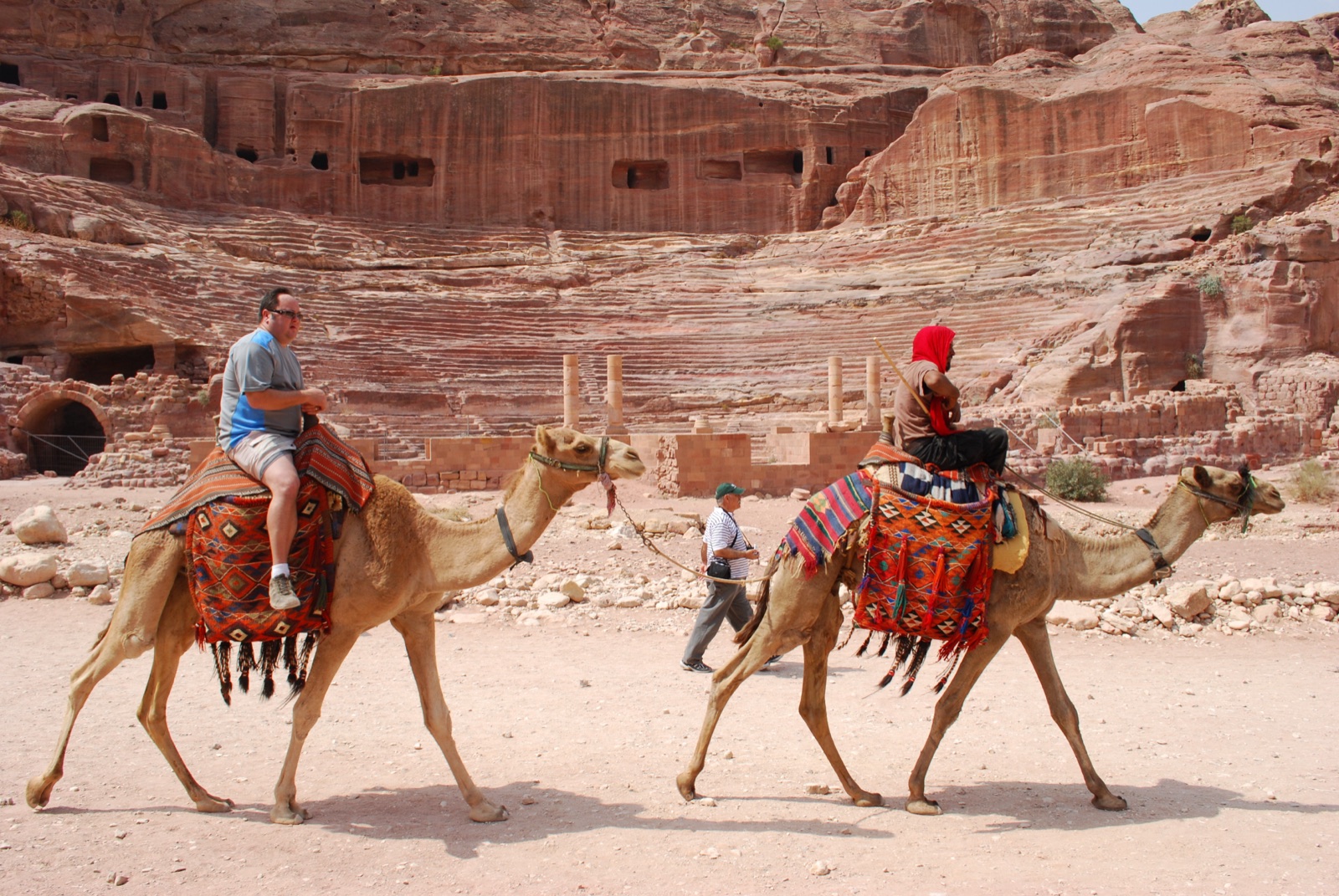
The theater
Cut into the hillside, the theater could seat around 8,500 people. It was damaged in the earthquake of 363.
The Royal Tombs
A row of grand facades on the cliff face: the Urn Tomb, the Silk Tomb, the Corinthian Tomb and the Palace Tomb. The Urn Tomb was later converted into a church.

The Colonnaded Street
The city’s main street, which the Romans lined with columns.

The Great Temple and Qasr al-Bint
The Great Temple was excavated and restored between 1993 and 2000. Qasr al-Bint is a temple in the Sacred Quarter, facing the Temple of the Winged Lions.
The Monastery (Ad Deir)

Petra’s largest monument sits high in the mountains above the city center: a facade about 45 meters tall and 50 meters wide. Reaching it means a long climb up a rock-cut stairway from near Qasr al-Bint, but it is one of the great rewards of a Petra visit — fewer people, a vast facade, and views across the mountains. Allow time, start before the midday heat and carry water.
The High Place of Sacrifice

On the summit of Jebel Madbah, the High Place of Sacrifice is an open-air Nabataean ceremonial site reached by a steep climb of around 800 steps from the theater area. The climb is hard work, but it gives some of the best views over Petra, and you can return a different way through Wadi Farasa.
Petra’s hiking trails

Petra’s official trails let you go well beyond the main route. The park’s trail list includes:
- The Main Trail — from the visitor center through the Siq to the Treasury, the theater and the Royal Tombs. This is the route every visitor walks.
- Al-Khubtha Trail — climbs from the Royal Tombs to a viewpoint high above the Treasury.
- The High Place of Sacrifice — up to Jebel Madbah and back, or onwards through Wadi Farasa to Qasr al-Bint.
- The Monastery trail — the stairway up to Ad Deir.
- Longer routes — including a back route to the Monastery and a trail between the Monastery and Little Petra.
Distances and difficulty vary, and some trails are best walked with a local guide. Check routes and current conditions at the visitor center before you set off.
How many days do you need?
The Jordan Pass sells Petra entry for one, two or three consecutive days, and that is a good guide:
- One day: the Siq, the Treasury, the theater, the Royal Tombs and the city center — and the Monastery if you start early and keep moving.
- Two days: add the Monastery at a relaxed pace and the High Place of Sacrifice or the Treasury viewpoint.
- Three days: time for the longer trails, Little Petra and a slower look at the details.
Many travelers continue from Petra to Wadi Rum; for the rest of the country, see the best places to visit in Jordan.
Tickets and the Jordan Pass
For most visitors the simplest option is the Jordan Pass. It comes in three versions — Jordan Wanderer, Jordan Explorer and Jordan Expert — with one, two or three consecutive days of entry to Petra, plus free entry to more than 40 other attractions. If you buy it before you arrive and stay in Jordan for at least two nights (three days), the tourist visa fee is waived. You can also buy Petra tickets at the visitor center. Prices and terms change, so check the official Jordan Pass website before you travel.
Tips for visiting Petra
- Start early. The Siq and the Treasury are at their quietest first thing, and you will want the cool morning hours for the climbs.
- Wear proper shoes and bring water, sun protection and layers — distances are long and many routes are steps and loose rock.
- Don’t touch the carvings — even light contact damages the sandstone over time.
- Stay in Wadi Musa, the town at the entrance, if you want an early start or more than one day.
- Consider a local guide. A guide brings the Nabataean story to life and knows the quieter trails.
Local-guided experiences

Petra Full-Day Guided Tour: Treasury, Monastery & Royal Tombs
Explore Petra’s highlights with a local guide, with hotel pickup and a boxed lunch.

2-Day Petra & Wadi Rum Tour: Guided Petra, Jeep Safari & Bedouin Camp
A Petra day tour, a cultural dinner, a Wadi Rum jeep tour and nights in Petra and Wadi Rum, with transport onwards to Aqaba.

7 Nights in Jordan: Iconic Landmarks & Christian Heritage
Petra, Wadi Rum, Amman and the Dead Sea, plus the Baptism Site, Madaba and Mount Nebo.
Petra FAQ
How many days do you need in Petra?
One full day covers the Siq, the Treasury and the city center, and the Monastery if you start early. Two or three days let you hike the trails at an easier pace; the Jordan Pass offers one, two or three days of entry.
What is the Treasury in Petra?
Al-Khazneh, a facade about 39 m high carved at the beginning of the 1st century AD — most likely the tomb of the Nabataean king Aretas IV, despite its name.
Is Petra included in the Jordan Pass?
Yes. The three Jordan Pass versions include one, two or three consecutive days in Petra, plus more than 40 other sites.
Why is Petra called the Rose City?
Because of the pink-red color of the sandstone its monuments are carved from.
When was Petra rediscovered?
The Swiss traveler Johann Ludwig Burckhardt brought Petra to Western attention in 1812; local Bedouin had always known it.
Sources
- Petra (Wikipedia) — history, Raqmu, Roman annexation, earthquake, Burckhardt, UNESCO and New 7 Wonders, theater, Royal Tombs, Great Temple, Qasr al-Bint, Monastery, High Place, Bdoul resettlement
- UNESCO — Petra — World Heritage inscription
- Al-Khazneh (Wikipedia) — dimensions, date, legend, carvings, Indiana Jones, visitor damage
- The Siq (Wikipedia) — length, width, formation, dam, niches, camel statues
- Petra Development & Tourism Region Authority — Trails 2025 — official trail list
- Jordan Pass — Petra entry days and visa condition
- Wikimedia Commons — photographs credited in each caption (CC BY / CC BY-SA)