Where are the best Roman ruins in Tunisia? Start with the amphitheater of El Jem, one of the largest Roman amphitheaters in the world, and Dougga, the best-preserved Roman town in North Africa, both UNESCO World Heritage Sites. Add Carthage, outside Tunis, and Bulla Regia, where Romans built their villas underground to escape the heat. Tunisia was the heart of the Roman province of Africa, and its museums hold some of the finest Roman mosaics anywhere. This guide covers the main sites, the lesser-known ones, how to combine them and how to visit with a local guide.
Planning a trip? Start with our complete Tunisia travel guide and our Tunisia itinerary.
Tunisia’s Roman sites at a glance
| Site | Region | Highlights | UNESCO |
|---|---|---|---|
| El Jem | The Sahel, south of Sousse | The great amphitheater and its museum | 1979 |
| Dougga | The north-west hills | Capitol, theater, temples, houses and streets | 1997 |
| Carthage | The coast near Tunis | Antonine Baths, Byrsa Hill, Punic Ports | 1979 |
| Bulla Regia | The north-west, near Jendouba | Underground villas with mosaics in place | — |
| Kerkuane | Cap Bon | A Punic town, untouched by Rome | 1985 |
| Thuburbo Majus | South of Tunis | Forum, capitol and baths in open farmland | — |
El Jem
The amphitheater of El Jem rises above a small town on the plain south of Sousse. Built in the 3rd century, when El Jem was the rich olive-oil city of Thysdrus, it could hold around 35,000 spectators and is one of the largest Roman amphitheaters ever built. UNESCO describes it as one of the finest surviving examples of its kind.
- Walk the tiers and look down into the arena.
- Explore the underground passages, where animals and gladiators waited.
- Visit the El Jem Museum, with mosaics from the villas of Thysdrus and a reconstructed Roman house.
El Jem is about an hour from Sousse and Monastir, an easy half-day trip. Read our guide to things to do in Sousse.

Dougga
Dougga, ancient Thugga, stands on a hillside among olive groves in the north-west, and UNESCO calls it the best-preserved Roman small town in North Africa. It began as a Numidian town before becoming Roman, and you can still walk its streets between houses, baths and temples.
- The Capitol, a temple to Jupiter, Juno and Minerva from the 2nd century, with its columns still standing.
- The theater, cut into the hillside with a view over the valley.
- The Libyco-Punic Mausoleum, a pre-Roman tower tomb.
- Temples, baths and houses along winding streets, with very few other visitors.

Carthage
Carthage, a short ride from central Tunis, was the great Phoenician city destroyed by Rome in 146 BC and rebuilt as the capital of Roman Africa. Visit the Antonine Baths by the sea, Byrsa Hill and its museum, the Punic Ports and the Roman villas. Read more in our guide to things to do in Tunis.
Bulla Regia
Bulla Regia is unique: to escape the summer heat, its wealthy citizens built their villas with a second floor underground. Several of these houses survive, with their mosaic floors still in place, as well as a theater, baths and a forum. It is often combined with Dougga and the Andalusian town of Testour.
Bulla Regia is in Jendouba province, in the north-west. The UK advises against all but essential travel to the Algerian border zones of Jendouba and El Kef, so check current advice for your route. Read our Tunisia safety guide.

More ancient sites
Tunisia has many more ancient sites beyond the big four, from Punic towns to Roman forums in farmland.
- Kerkuane: a Punic town on Cap Bon, abandoned in the 3rd century BC and never rebuilt by Rome, with houses and bathtubs still visible. A UNESCO site.
- Thuburbo Majus: a Roman town with a forum and capitol, about an hour south of Tunis.
- Utica: one of the oldest Phoenician settlements in North Africa, north of Tunis.
- Sbeitla: ancient Sufetula, with three temples side by side. It is in Kasserine province, where the UK advises against all but essential travel.
Where to see the mosaics
Tunisia’s Roman mosaics are among the finest in the world, and the best of them are in museums.
- The Bardo National Museum, Tunis: one of the largest collections of Roman mosaics anywhere.
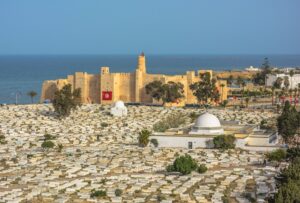
- The Sousse Archaeological Museum: a superb collection inside the Kasbah of Sousse.
- The El Jem Museum: mosaics from the villas of Thysdrus.
How to combine the sites
The best way to combine Tunisia’s ancient sites is to use Tunis and Sousse as bases for day trips.
| Base | Day trip |
|---|---|
| Sousse or Monastir | El Jem (half day), with the Sousse museum |
| Tunis | Carthage and the Bardo (one day) |
| Tunis or Sousse | Dougga, Bulla Regia and Testour (long full day) |
| Hammamet or Tunis | Kerkuane and Cap Bon (one day) |
Travel with a local guide
Simsem’s Tunisia host, Mohamed Ben Naceur, runs private tours to El Jem and to Dougga and Bulla Regia from Sousse:

El Jem Amphitheater Private Tour
A private trip from Sousse or Monastir to the great Roman amphitheater of El Jem, a UNESCO site.

Dougga, Bulla Regia and Testour
A full day to the Roman city of Dougga, the underground villas of Bulla Regia and Andalusian Testour.
See all Tunisia experiences on Simsem.
FAQ
What are the best Roman ruins in Tunisia?
The amphitheater of El Jem and the town of Dougga, both UNESCO sites, plus Carthage, Bulla Regia and Thuburbo Majus.
How big is the El Jem amphitheater?
It could hold around 35,000 spectators, making it one of the largest Roman amphitheaters in the world.
How do you get to El Jem?
By road or train, about an hour from Sousse or Monastir. Many visitors go on a half-day tour.
Why is Dougga special?
UNESCO calls it the best-preserved Roman small town in North Africa, with its Capitol, theater, temples and streets set among olive groves.
What is unique about Bulla Regia?
Its Roman villas had underground floors to keep cool in summer, and several still have their mosaics in place.
Where can I see Roman mosaics in Tunisia?
At the Bardo National Museum in Tunis, the Sousse Archaeological Museum and the El Jem Museum.