

Jordanian food is built around the shared table. The national dish, mansaf, arrives on one big platter for everyone; breakfast is a spread of small plates you scoop up with bread; and a visit to anyone’s home, or even a shop, comes with coffee or tea whether you planned on it or not. This guide walks you through 25 dishes worth knowing in Jordan — what goes into each one, how it is made, where it comes from and how locals eat it — plus where to try them in Amman, the regional specialities to look out for, and the drinks and sweets that finish every meal.

Jordanian food at a glance
| Dish | What it is | When locals eat it |
|---|---|---|
| Mansaf | Lamb cooked in a yogurt sauce, served on bread and rice | Weddings, holidays, honouring guests |
| Maqluba | Layered rice, meat and fried vegetables, flipped out of the pot | Family meals and gatherings |
| Zarb | Bedouin meat and vegetables slow-cooked underground | Desert camps in the south |
| Musakhan | Roast chicken with sumac onions on taboon bread | Olive-harvest season and family meals |
| Galayet bandora | Tomatoes stewed with onions, chilli and olive oil (vegetarian) | Any time; a camping favourite |
| Makmoura | A pie filled with chicken and onions | Home cooking |
| Kubbeh | Bulgur shells stuffed with spiced minced meat | Mezze and family meals |
| Mjadarra | Rice and lentils with caramelised onions (vegetarian) | Everyday home cooking |
| Sayyadieh | Spiced rice with onions, topped with fish | Aqaba, by the Red Sea |
| Cha’acheel | Wild greens shaped into balls and cooked in yogurt | Village cooking around Ajloun |
| Hummus | Chickpea purée with tahini, lemon and garlic (vegetarian) | Breakfast and mezze |
| Falafel | Deep-fried chickpea balls (vegetarian) | Breakfast and street food |
| Ful | Fava beans mashed with olive oil, lemon and chilli (vegetarian) | Breakfast |
| Msabbaha | Hummus with whole chickpeas, tahini and olive oil (vegetarian) | Breakfast |
| Fattet hummus | Hummus layered with pieces of pita and tahini (vegetarian) | Breakfast |
| Manakish | Flatbread topped with olive oil and za’atar or cheese (vegetarian) | Breakfast, on the go |
| Labaneh | Thick strained yogurt, eaten with bread and olive oil (vegetarian) | Breakfast |
| Shawarma | Spit-grilled meat in bread with tahini and pickles | Any time, on the go |
| Mutabbal | Roasted aubergine mashed with tahini and lemon (vegetarian) | Mezze |
| Fattoush | Salad with fried pita and sumac (vegetarian) | Mezze |
| Warak dawali | Vine leaves rolled around rice and meat | Family meals |
| Knafeh | Cheese pastry soaked in syrup (vegetarian) | After meals, Ramadan |
| Qatayef | Filled pancake-dumplings (vegetarian) | Ramadan |
| Baklava | Layered pastry with nuts and syrup (vegetarian) | Any time |
| Ma’moul | Semolina pastries filled with dates or nuts (vegetarian) | Any time, with coffee |
The signature dishes
1. Mansaf — the national dish
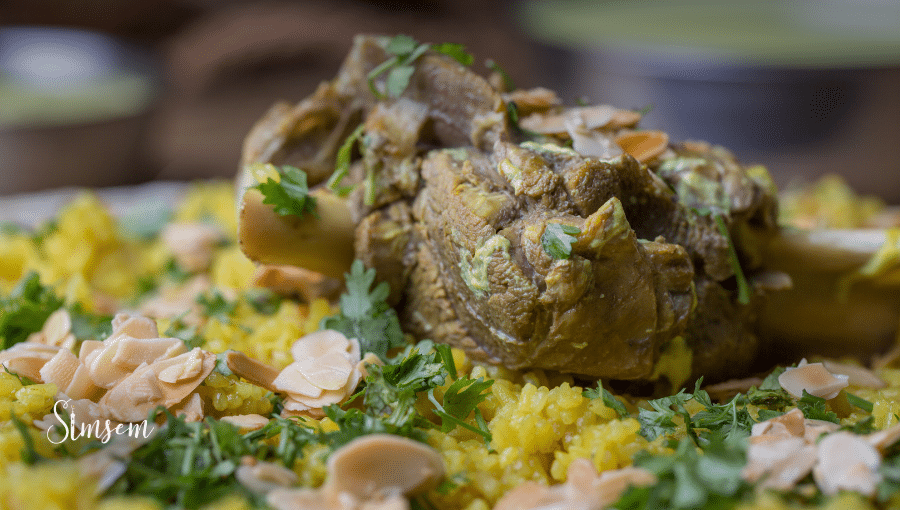
What it is. Mansaf is lamb (or sometimes goat) cooked in a yogurt sauce and served over rice on a base of thin bread, and it is widely called Jordan’s national dish. In 2022 UNESCO added “Al-Mansaf in Jordan, a festive banquet and its social and cultural meanings” to its list of the world’s intangible cultural heritage. The name comes from an Arabic word for a large tray or dish, which is exactly how it is served.
Ingredients. Lamb on the bone; jameed — yogurt that has been salted, dried and shaped into hard balls, then dissolved again to make the sauce; rice (bulgur in older or northern versions); thin flatbread such as shrak; and fried almonds or pine nuts scattered on top. The town of Karak has a reputation for the best jameed.
How it is made. The meat is cut into large pieces and simmered for hours in the jameed sauce with spices. The platter is built in layers — bread, then rice, then the meat — garnished with nuts, and more of the hot yogurt sauce is poured over the top. UNESCO notes that the cooking itself is a social event, with cooks talking, telling stories and singing while it is prepared.
A bit of history. Mansaf has its roots in Bedouin life, and early versions were simply meat, broth or ghee, and bread. Rice spread through the region during the 20th century, first mixed with bulgur and later on its own, and after independence mansaf was promoted as the national dish.
How locals eat it. Mansaf is served at weddings, births, graduations, holidays such as Eid, Christmas and Easter, and whenever a family wants to honour guests. Traditionally five to seven people gather around one platter and eat with the right hand only, keeping the left hand behind the back, pressing rice and meat into small balls. Today many families also use plates and spoons, and nobody expects a visitor to master the technique on the first try. Al-Salt and Karak both claim to make the best version.
Where to try it. At a family table if you get the invitation — it is a home dish first. In Amman, Al-Quds Restaurant and Sufra are both known for it; read our mansaf guide for more.
2. Maqluba — the upside-down pot
What it is. Maqluba means “upside down”, and the name describes the big moment: the pot is turned over onto a platter so the dish stands like a layered cake. It is cooked across the Levant and is a staple of Jordanian family gatherings.
Ingredients. Chicken or lamb, rice, and fried vegetables — cauliflower and aubergine are the classics, with tomatoes or potatoes in some homes — finished with pine nuts and parsley.
How it is made. The vegetables are fried first, then meat, vegetables and rice are layered in a deep pot and cooked together. At the table the pot is inverted in one confident flip; a clean, standing shape is a point of pride for the cook.
A bit of history. The name appears in a 13th-century Baghdad cookbook, although there it described an egg dish; the rice version is the one cooked across the region today.
How locals eat it. With plain yogurt and a simple salad on the side, at weekend lunches and large gatherings.
3. Zarb — the Bedouin underground roast
What it is. Jordan’s Tourism Board calls zarb perhaps the most dramatic of the traditional cooking methods: lamb or chicken, sometimes with herbs and vegetables, buried in an oven with hot coals beneath the desert sand.
How it is made. The meat and vegetables go into a lidded pot that is lowered into a pit over hot coals and covered with sand. Hours later the sand is brushed away and the lid lifted, and the slow-roasted meat comes away from the bone.
Where to try it. Zarb is especially popular in Bedouin areas such as Petra and Wadi Rum, where desert camps serve it for dinner — see our zarb guide and things to do in Wadi Rum.
4. Musakhan — chicken, sumac and taboon bread
What it is. Roast chicken served on taboon bread that has soaked up olive oil and a deep layer of onions cooked with sumac, finished with pine nuts. It is a Palestinian dish, from the area around Tulkarm and Jenin, and is particularly popular in Jordan.
Ingredients. Chicken, plenty of onions, sumac, allspice and saffron, olive oil, pine nuts and taboon bread.
How it is made and eaten. The onions are cooked slowly with sumac until soft and sharp, spread over the bread, and the roast chicken goes on top. It is eaten by hand, tearing the bread. It is traditionally cooked during the olive harvest, when new olive oil is at its best; modern versions roll it into thin saj-bread wraps.
5. Galayet bandora — tomatoes in a pan
What it is. The name translates as “tomato in a pan”, and that is the whole idea: tomatoes, onions, garlic and hot peppers cooked down in olive oil until thick. It is simple, fast and loved — popular across the Levant and especially in Jordan, where King Abdullah II named it his favourite dish in 2019.
How locals eat it. Scooped up with warm bread, often cooked outdoors over a small fire on a picnic or camping trip, or during the olive harvest. Some versions add minced meat or eggs.
6. Makmoura
A pie filled with chicken and onions, a home-cooked dish that is less known to visitors than mansaf, which is exactly why it is worth seeking out — our makmoura guide explains more.
7. Kubbeh
A shell of bulgur mixed with meat, stuffed with spiced minced meat, pine nuts, onions and sumac, and usually fried. You will also meet kubbeh labaniyyeh, simmered in a jameed yogurt sauce, and kubbeh nayyeh, served raw.
8. Mjadarra
Rice cooked with lentils, onions and cumin, topped with a heap of caramelised onions. It is everyday home food, cheap and filling — and one of the easiest vegetarian mains to find.
9. Sayyadieh
The fisherman’s dish of the south: rice cooked with caramelised onions and spices, topped with fish that may be grilled, baked or fried. Look for it in Aqaba, Jordan’s only city on the coast, where fresh seafood is part of everyday eating.
10. Cha’acheel
A village dish that even many Jordanians have never tried. In the Rasoun area of Ajloun, wild greens called loof are cooked with onions, bound with flour and eggs into small balls and simmered in a yogurt sauce called labaniyyeh. It is the kind of dish you only meet on a home visit — another reason to spend time in the green north around Ajloun.
Breakfast and street food

A Jordanian breakfast is a table of small plates and a stack of bread, and in downtown Amman people eat it at long shared tables, often standing room only. Jordan’s Tourism Board sums up Amman’s street food as creamy hummus, falafel sandwiches and bowls of steaming stewed fava beans, with shawarma for later in the day and fresh sugar-cane juice from small kiosks.
11. Hummus
Chickpeas puréed with tahini, lemon and garlic, swirled on a plate and finished with olive oil. Eaten with bread rather than a spoon.
12. Falafel
Deep-fried balls of ground chickpeas and herbs — in Jordan they tend to be smaller than elsewhere, and come fresh from the fryer in a sandwich or on a plate.
13. Ful
Dried fava beans cooked and mashed with olive oil, lemon, chilli and tomatoes; topped in some places with sumac.
14. Msabbaha
Hummus served with whole chickpeas, extra tahini and lemon, drizzled with olive oil — warmer and looser than ordinary hummus.
15. Fattet hummus
Pieces of pita layered with hummus, tahini and yogurt, often with pine nuts and almonds on top — a heavier, more filling breakfast.
16. Manakish
Flatbread brushed with olive oil and topped with za’atar — a mix of thyme, sesame, sumac and salt — or with white cheese, baked and eaten on the go.
17. Labaneh
Thick, tangy strained yogurt, spread on bread and drizzled with olive oil; at breakfast it sits next to olives and the za’atar dish.
18. Shawarma

Chicken, beef or lamb grilled on a vertical spit, shaved into pita or thin shrak bread and finished with tahini, pickles, tomatoes and onions. Amman takes its shawarma seriously; queues at the best counters are part of the experience.
Mezze: the shared starters
A spread of mezze starts almost every meal in an Arabic restaurant in Jordan — hummus, mutabbal, muhammara and many more dishes for dipping with bread. Much of it is vegetarian, and a good mezze can easily be a meal in itself.
19. Mutabbal
Roasted aubergine mashed with tahini, olive oil and lemon — smoky and creamy. (Baba ghanoush, its cousin, is mixed with diced tomato, pepper and pomegranate rather than tahini.)
20. Fattoush
A chopped salad lifted by pieces of fried pita and a sharp hit of sumac.
21. Warak dawali
Vine leaves rolled tightly around rice and meat and cooked in stock, sometimes layered with meat and tomato slices in the pot. A rice-only version, yalangee, is cooked with lemon juice and olive oil.
Sweets and desserts

Jordanians have a famous sweet tooth: ending a meal without something sweet is close to unthinkable. Sweetshop windows are stacked with baklava, rolled pastries and bird’s-nest pastries filled with pistachio, and huge round trays of knafeh are cut to order. See our guide to Jordanian desserts for more.
22. Knafeh
What it is. A warm cheese pastry soaked in syrup — the dessert most visitors remember. The version most common in Jordan is knafeh nabulsiyeh, named after the Palestinian city of Nablus where it originated.
How it is made. Fine shredded pastry (or a semolina dough) is pressed into a buttered pan and layered with a mild white cheese. It is cooked until the cheese melts, soaked with a sugar syrup scented with rose or orange-blossom water, and finished with crushed pistachio.
A bit of history. Stories trace knafeh to the kitchens of medieval caliphs, but historians note that cheese-filled knafeh is only documented from the 19th century.
Where to try it. Habibah, in a downtown Amman alley since 1951, is the city’s best-known address — expect a queue and eat it hot, standing up.
23. Qatayef
Small pancakes folded around cream and pistachio — a sweet you mostly find during Ramadan.
24. Baklava
Thin layers of pastry filled with pistachios and soaked in syrup or honey, cut into diamonds in every sweetshop window.
25. Ma’moul
Semolina pastries filled with dates, pistachios or walnuts. Also look for warbat, pastry triangles filled with clotted cream, and um ali, a warm bread pudding with nuts and raisins.
What to drink

- Arabic coffee — roasted and ground with cardamom and served in small cups. No Jordanian meal is complete without coffee, and it is customary to be offered several cups when you visit a family, or even a shop.
- Tea with sage or mint — black tea flavoured with fresh sage or mint and plenty of sugar, the drink of every break, campfire and conversation.
- Sugar-cane juice — pressed fresh at street kiosks in Amman.
- Sahlab — hot milk thickened with orchid-root starch and topped with coconut and cinnamon.
- Tamar hindi — a sweet-and-sour tamarind drink that appears everywhere during Ramadan.
Regional specialities
- The Bedouin south — Petra and Wadi Rum: zarb at desert camps, and mansaf in its original Bedouin setting. Bedouin communities in the east and south also eat more lamb than the rest of the country.
- Karak and Al-Salt: two towns with a claim to the best mansaf, and Karak to the best jameed. In Al-Salt, a traditional breakfast in a heritage home is part of Simsem’s heritage walk.
- Ajloun and the green north: village dishes such as cha’acheel, homemade lunches in family homes around Jerash, and olive oil — Jordan has some of the oldest olive trees in the region.
- Aqaba: fresh fish, sayyadieh, and even a fish version of mansaf.
- Dates: Jordan grows many varieties, and the large Medjool is considered the king of them.
Where to eat in Amman
These are long-established places, each recommended by several independent sources. Opening hours change, so check the map listing before you go. Last checked: 1 November 2026.

- Hashem Restaurant — downtown (Al-Balad). Serving falafel, hummus and ful since 1952, with tables spilling into the lane; one of the city’s oldest restaurants and a favourite with locals and visitors alike. Order: falafel, hummus, ful, mutabbal. Google Maps
- Habibah Sweets — downtown. In a narrow alley near the Arab Bank since 1951 — the city named the alley after the founder, Haj Mahmoud Habibah. Order: hot knafeh. Google Maps
- Shawerma Reem — 2nd Circle. A takeaway counter making one thing, meat shawarma, since 1975; there is nearly always a queue. Google Maps
- Al-Quds Restaurant — downtown, King Hussein Street. A traditional downtown restaurant whose speciality is mansaf. Google Maps
- Sufra — Rainbow Street. A restaurant serving Jordanian classics, including mansaf, on Rainbow Street. Google Maps
Eat with a local

The best Jordanian food is cooked at home, and the easiest way into a home kitchen is with a local host. These Simsem experiences include real meals — check each listing for exactly what is served.

Amman Uncovered: A Walking Tour of Flavor and Tradition
Downtown markets, tastings of traditional food and sweets, and coffee with your local guide.

Amman Full-Day City Tour: History, Culture & Local Food
The Citadel and Roman Theatre, downtown markets, lunch at Hashem and knafeh from Habibah.

As-Salt Heritage Walk: Culture, Stories & Local Breakfast
A slow walk through Al-Salt with a traditional breakfast inside a heritage home.

Zubiya Forest Trail & Local Village Lunch
A forest hike in the north ending with a homemade lunch in a family home in Jerash.

Jerash Roman City Experience: History, Walk & Local Dinner
Roman Jerash told as a story, with breakfast in the botanical garden and a local dinner.

Beekeeping Adventures & Rustic Breakfast in Jerash
A vegetarian countryside breakfast in a Jordanian home, a forest walk and a bee workshop.
How to eat like a Jordanian
- Expect generosity. Hospitality runs through every meal — a local saying describes a Jordanian invitation as one where you “bring nothing and eat everything”. When food is served you will hear sahtain, a wish for your health and wellbeing.
- Bread is your cutlery. Hummus, ful, labaneh and galayet bandora are scooped up with flatbread rather than eaten with a spoon.
- Use your right hand for shared platters such as mansaf.
- Vegetarians eat well. Mezze, hummus, falafel, ful, mjadarra, manakish and galayet bandora are all meat-free.
- Ramadan changes the rhythm. Qatayef and tamar hindi appear everywhere during the holy month. See our guide to Ramadan in Jordan, and our Jordanian culture guide for wider etiquette.
Jordanian food FAQ
What is Jordan’s national dish?
Mansaf: lamb cooked in a sauce made from jameed (dried yogurt), served over rice on thin bread and topped with nuts. UNESCO recognised it as intangible cultural heritage in 2022.
What do Jordanians eat for breakfast?
A spread of small plates — hummus, falafel, ful, labaneh, olives, za’atar with olive oil and plenty of bread, with sweet tea.
What is the best dessert in Jordan?
Knafeh, a warm cheese pastry soaked in syrup and topped with pistachio; Habibah in downtown Amman has served it since 1951.
Where can I try zarb?
At Bedouin desert camps around Wadi Rum and Petra, where the meat is slow-cooked underground over hot coals.
Is Jordanian food good for vegetarians?
Yes. Many mezze dishes and breakfast staples are meat-free, as are mjadarra and galayet bandora; ask about stock in rice dishes.
Sources
- UNESCO — Al-Mansaf in Jordan (2022) — mansaf’s ingredients, serving, right-hand custom and social meaning
- Jordan Tourism Board — Taste of Jordan — zarb, mezze, Amman street food, sweets, coffee customs, cha’acheel, sayyadieh, sahtain and dish glossary
- Mansaf (Wikipedia) — jameed, history, occasions, regional variants
- Jordanian cuisine (Wikipedia) — makmoura, kubbeh, breads, drinks, regional eating, hospitality
- Maqluba (Wikipedia) — name, method and early history
- Musakhan (Wikipedia) — ingredients, origin and olive-harvest tradition
- Galayet bandora (Wikipedia) — ingredients, how it is eaten
- Knafeh (Wikipedia) — method, Nablus origin, history
- Lonely Planet — Best kunafeh in Amman and Jordan News — Mahmoud Habibah Street — Habibah
- Migrationology — Hashem Restaurant — Hashem
- Jordan News — How Shawerma Reem became a Jordanian institution — Shawerma Reem
- World Travel Guide — Amman food and drink guide — Al-Quds and Sufra


