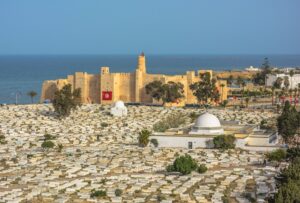
Is Tunisia safe to visit? Yes, for the places almost all visitors go. Tunisia is not at war, and more than 11 million international tourists visited in 2025, a record. The US rates Tunisia Level 2, “Exercise increased caution,” the same level it gives France, Germany, Spain and the United Kingdom. Both the US and UK advise against travel to a few specific areas: the mountains near the Algerian border around Kasserine, and the zone along the border with Libya. Tunis, Carthage, Sidi Bou Said, Sousse, Monastir, Hammamet, Djerba, El Jem and the Sahara oases of Tozeur and Douz are all outside them. This guide explains the official advice, the risks, everyday safety and practical tips, with every source linked.
Planning a trip? Start with our complete Tunisia travel guide and our Tunisia visa guide.
The short answer
- Is Tunisia safe for tourists? Yes, in the main cities, resorts, archaeological sites and Sahara oases.
- Is there a war or conflict? No. Tunisia is not at war.
- What does the US say? Level 2, “Exercise increased caution” (reissued May 21, 2026), the same level as France and the UK.
- Where should I not go? The Chaambi mountains and nearby military zones in Kasserine province, and the area along the Libyan border.
- How many people visit? More than 11 million international tourists in 2025, a record, including record numbers from the UK.
What official travel advice says
Official advice for Tunisia is moderate overall, with firm warnings for a few border areas. Here is how two governments describe it as of November 2026.
| Government | Overall | Do not travel | Avoid unless essential |
|---|---|---|---|
| United States | Level 2: Exercise increased caution (May 21, 2026) | Mount Chaambi National Park and the Mount Salloum, Mount Sammamma and Mount Mghila areas in Kasserine province; within 16 km of the Libyan border | — |
| United Kingdom | No advice against most of the country (updated July 24, 2026) | The Chaambi Mountains National Park and the military zones of Mount Salloum, Mount Sammamma and Mount Mghila; the militarized zone south of El Borma and Dhehiba; within 20 km of the Libyan border north of Dhehiba; Ben Guerdane | Areas north and west of Ghardimaou; the Algerian border zones in El Kef and Jendouba; Kasserine province, including Sbeitla; Mount Orbata; within 75 km of the Libyan border (not including Zarzis) |
Note that the Roman site of Sbeitla, in Kasserine province, falls in the UK’s “all but essential travel” area. If you plan to visit the north-west near the Algerian border, check your exact route against current advice. Always read the latest version for your own country before you travel.

Where visitors go
Tunisia’s main sights are well outside the restricted areas, and they receive millions of visitors every year.
- Tunis, Carthage and Sidi Bou Said on the north coast.
- The Sahel coast: Sousse, Monastir, Hammamet, Mahdia and the amphitheater of El Jem.
- Kairouan and the Roman city of Dougga.
- Djerba island and the coast of Zarzis.
- The Sahara: Tozeur, Nefta, Douz, Matmata and Ksar Ghilane, usually visited with a local driver or tour.
Terrorism and security
Tunisia suffered serious terrorist attacks in 2015, at the Bardo Museum in Tunis and on a beach near Sousse. Security at museums, hotels, airports and tourist areas has been heavily reinforced since then, and tourism has recovered to record levels. Governments still say attacks are possible, as they do for much of Europe.
- Expect visible security: police at hotels, museums and checkpoints on main roads.
- Carry your passport or a copy at all times.
- Avoid demonstrations and large political gatherings.
- Don’t photograph police, soldiers or government buildings.
Everyday safety and scams
For most visitors, the main annoyances in Tunisia are touts and taxis, not crime.
- Taxis: insist on the meter in cities, or agree on the fare first.
- “Guides” in the medina: friendly strangers may offer to show you a “special” shop; a polite no is enough.
- Petty theft: watch bags and phones in crowded souks, on the TGM train and on beaches.
- Driving: road accidents are a bigger risk than crime. Avoid driving long distances at night.
- Heat: in summer, carry water and avoid the midday sun, especially in the south.
Is Tunisia safe for women and solo travelers?
Tunisia is one of the most liberal countries in North Africa, and women travel there alone and in groups. Unwanted comments and attention are the most common complaints. Dress modestly away from beaches and resorts, use registered taxis at night and sit with other women or families on public transport where possible. A local guide makes the medinas and the south much more relaxed for solo travelers.
Money and documents
Money and paperwork in Tunisia are simple if you know two rules: the dinar can’t leave the country, and many nationalities need no visa.
- Visa: many nationalities, including US and UK citizens, can visit without a visa for up to 90 days. See our Tunisia visa guide.
- Currency: the Tunisian dinar cannot be taken out of the country. Keep your exchange receipts, and declare foreign currency on arrival if required.
- Cards: accepted in hotels and many restaurants in tourist areas, but carry cash for markets, taxis and small shops.
- Insurance: check that your policy covers your route, especially if you go near the border areas.
Travel with a local guide
Simsem’s Tunisia host, Mohamed Ben Naceur, is based in Sousse and runs tours along the coast and to the Roman sites:

Sousse Medina Walking Tour
A walk with Mohamed through the UNESCO-listed medina of Sousse, its souks, the Ribat and the Great Mosque.

El Jem Amphitheater Private Tour
A private trip from Sousse or Monastir to the great Roman amphitheater of El Jem, a UNESCO site.

Dougga, Bulla Regia and Testour
A full day to the Roman city of Dougga, the underground villas of Bulla Regia and Andalusian Testour.
See all Tunisia experiences on Simsem.
FAQ
Is it safe to travel to Tunisia right now?
Yes, for the main tourist areas. The US rates Tunisia Level 2, “Exercise increased caution,” and advises against only a few mountain areas near the Algerian border and the zone along the Libyan border.
Is there a war in Tunisia?
No. Tunisia is not at war. Travel warnings focus on terrorism risks in specific border areas.
Is Sousse safe for tourists?
Yes. Sousse is one of Tunisia’s busiest resorts, with strong security around hotels and the medina. Take normal precautions with valuables.
Is Djerba safe?
Yes. Djerba is a popular island resort outside the areas governments advise against.
Can I visit the Tunisian Sahara safely?
Yes. Tozeur, Douz, Matmata and Ksar Ghilane are visited by many tourists. Stay away from the Libyan border zone and travel with a local driver or tour in the desert.
Is Tunisia safe for women traveling alone?
Many women travel alone in Tunisia. Unwanted attention is the main issue; modest dress away from beaches and a local guide help.
Sources
- US Department of State — Tunisia Travel Advisory (Level 2, May 21, 2026)
- UK Foreign, Commonwealth & Development Office — Tunisia travel advice (updated July 24, 2026)
- APA News — Tunisia shatters records with over 11 million tourists in 2025
- UK FCDO — Tunisia entry requirements
- Wikimedia Commons — photographs credited in each caption