

Floating in the Dead Sea is one of those travel experiences that is exactly as strange as people say. Lie back and the water simply holds you up — no effort, no swimming, just you, a salty glare and the mountains of the far shore. Its shores are the lowest land on earth, about 440 metres below sea level, and the water is close to ten times saltier than the ocean. From Amman, Jordan’s eastern shore is an easy day trip. This guide covers why you float, how to visit on the Jordan side, how to float and use the mud safely, the best time to go, why the sea is shrinking, and what else to see nearby.
The Dead Sea at a glance
| Topic | The quick answer |
|---|---|
| How low | About 440 m below sea level (2025) — the lowest land on earth |
| How salty | About 34% salt, roughly 9.6 times saltier than the ocean (2011 measurement) |
| Where to go in Jordan | The resort area on the north-east shore, or a public beach a little further south |
| Climate | Hot desert: summer averages around 32–39 °C, winter around 20–23 °C, very little rain |
| Combine with | Madaba, Mount Nebo, the Baptism Site, Ma’in Hot Springs, Wadi Mujib |
Why you float
Salt makes water heavy. In 2011 the Dead Sea measured about 34% salinity — roughly 9.6 times saltier than the ocean — which gives the water a density of about 1.24 kilograms per litre. Your body is lighter than that, so you sit high in the water whether you try to or not. The sea is also deep: the main northern basin is about 50 km long and up to 15 km wide, and around 300 metres deep at its deepest, making it the deepest hypersaline lake in the world.
The water is unusually rich in minerals — magnesium, calcium, potassium and bromide, with the highest bromide concentration of any water on earth — and potash and bromine are extracted from it on an industrial scale.
How to visit on the Jordan side
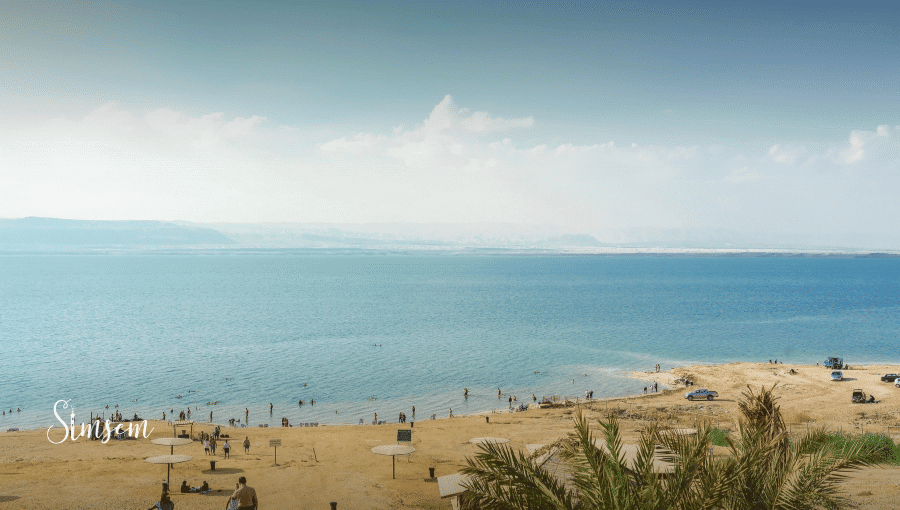
Most of Jordan’s Dead Sea resorts are grouped at the northern end of the shore, near the King Hussein Bin Talal Convention Center. There are two main ways to get into the water.
- A resort beach. Nine international-brand hotels line this stretch of shore, and the resorts along the northern shore have private beaches, pools and spa facilities. Staying overnight, or using a resort’s facilities for the day, is the most comfortable option.
- A public beach. Amman Beach (Amman Beach Tourism Resort), about 2 km south of the main resort strip, has offered more affordable access to the sea. Its status has changed over the years — it was reported closed in 2020 and later described as open again — so check that it is operating before you go. In May 2026 Jordan’s news agency reported a public beach on the Dead Sea drawing a record 4,000 visitors over a weekend.
Wherever you swim, use a designated bathing area: the shoreline has shifted as the sea has dropped, and the ground off-beach can be unstable.
About 5 km south of Amman Beach, a turn-off with steep switchbacks climbs to the Dead Sea Panorama complex, with views over the water and the Dead Sea Museum, which introduces the sea’s history, geology and ecology.
How to float — and the mud
- Walk in, then lie back. Wade in to about waist depth, sit back as if into a chair and let the water lift your legs. Floating on your back is the whole point — swimming face-down and splashing is how people get the water in their eyes.
- Keep it out of your eyes and mouth. The water stings badly and should not be swallowed. Keep a bottle of fresh water and a towel on the shore for your hands and face.
- Don’t shave beforehand, and keep the water away from fresh cuts — the salt will find them.
- Take breaks. The salt and the heat tire you faster than you expect. Float for a while, come out, rinse off, drink water, and go back in if you feel like it; get out straight away if you feel unwell.
- The black mud. Many visitors cover themselves in the dark mineral mud from the shore, let it dry in the sun for a while, then wash it off in the sea before a fresh-water shower.
The Dead Sea has a long reputation for health benefits. Some of these have research behind them — sun exposure at the Dead Sea has been studied as a treatment for psoriasis, and mud packs may temporarily ease knee pain from osteoarthritis — but they are suggested benefits rather than established cures. If you have a medical condition, ask your doctor before treating a visit as therapy.
When to go
The Dead Sea has a hot desert climate with dry air and less than 50 mm of rain a year. Summer days average around 32–39 °C and the temperature passes 30 °C on about 190 days a year, while winter days average a pleasant 20–23 °C. That makes the cooler months — roughly autumn through spring — the most comfortable time for a day of floating, while summer visits are best kept to the morning or late afternoon. Whatever the season, bring plenty of drinking water and sun protection for a day on the shore.
A sea that is shrinking
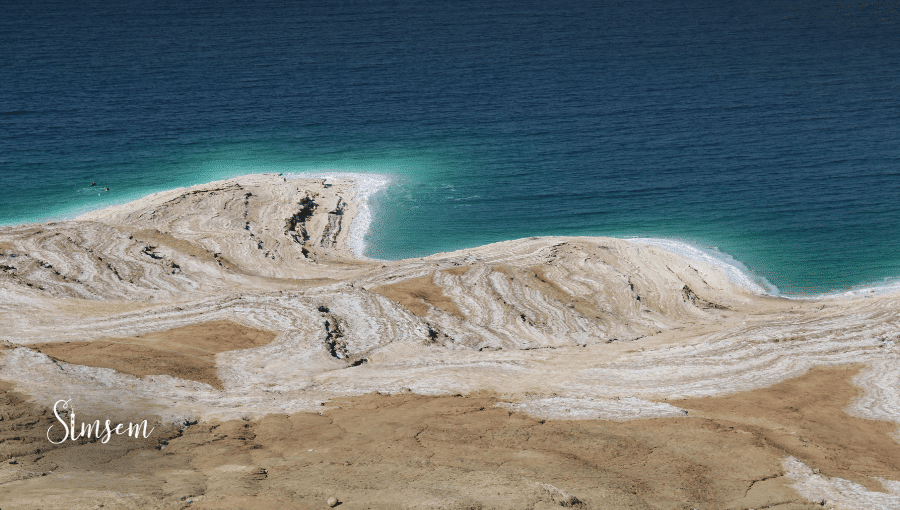
The Dead Sea is getting smaller. Its surface area has fallen from about 1,050 km² in 1930 to roughly 605 km² in 2016, and its level has been dropping by more than a metre a year. The main cause is the diversion of the Jordan River, which once fed it, together with reduced inflows; as the water retreats, sinkholes have opened along parts of the shore. A planned Red Sea–Dead Sea water conveyance project intended to slow the decline was scrapped. If you have ever wanted to float here, there is a reason not to leave it too long.
What to see nearby
- Madaba and Mount Nebo — mosaics and the view of Moses, on the plateau above the sea; see our Madaba & Mount Nebo guide.
- Bethany Beyond the Jordan — the Baptism Site on the Jordan River, included in the Jordan Pass.
- Wadi Mujib — a canyon that runs down to the Dead Sea; see our Wadi Mujib guide.
- Ma’in Hot Springs — thermal springs in the hills above the sea; see our Ma’in guide.
- Machaerus (Mukawir) — the hilltop fortress on the eastern side associated by the historian Josephus with the imprisonment and death of John the Baptist.
For more of the country, see our guides to the best places to visit in Jordan and Jordan travel tips.
Local-guided experiences

Jordan Explorer: Madaba, Mount Nebo & Dead Sea Wonders
Madaba’s mosaics, the view from Mount Nebo and a float in the Dead Sea, with a traditional Jordanian breakfast and lunch and round-trip transport.

7 Nights in Jordan: Iconic Landmarks & Christian Heritage
Petra, Wadi Rum, Amman and the Dead Sea, plus the Baptism Site, Madaba and Mount Nebo, with transport, guide, meals and accommodation as listed.
Dead Sea FAQ
Why can’t you sink in the Dead Sea?
Because the water is so salty — about 34% salt, with a density of around 1.24 kg per litre — it is denser than your body, so it holds you up.
How far below sea level is the Dead Sea?
About 440 metres below sea level as of 2025, which makes its shores the lowest land on earth. The level is still falling by more than a metre a year.
Is there a public beach on the Jordanian side?
Amman Beach, about 2 km south of the resort strip, has offered public access, but its status has changed over the years — check that it is open before you go. Otherwise, the resorts have their own beaches.
What is the best time of year to visit?
The cooler months, roughly autumn to spring. Summer averages 32–39 °C, so go early or late in the day.
Is the Dead Sea mud good for your skin?
Many visitors use it and some benefits have been studied, but they are suggested rather than proven medical treatments.
Sources
- Dead Sea (Wikipedia) — elevation, salinity, density, dimensions, minerals, climate, shrinking, health research, Jordanian hotel area, Machaerus
- Lonely Planet — Dead Sea attractions and Rough Guides — Dead Sea beaches — Amman Beach location, Dead Sea Panorama
- Jordan News — public beach — Amman Beach closure report (2020)
- Petra News Agency — Dead Sea public beach (May 2026) — public beach visitor numbers
- Accessible Jordan — Dead Sea — resort beaches and facilities
- AAA TripCanvas — Dead Sea Museum — museum content
- Encounters Travel — swimming in the Dead Sea and Traveller — Dead Sea swimming tips — floating and safety tips
- Jordan Pass — sites — Bethany Beyond the Jordan included


